
The blog · GTM Systems · From The Demand Compass · 6 min
What is a Market Map and a Signal Radar?
The Map is a live, account-level view of the whole market; the Radar is what sweeps every account and keeps that view honest.
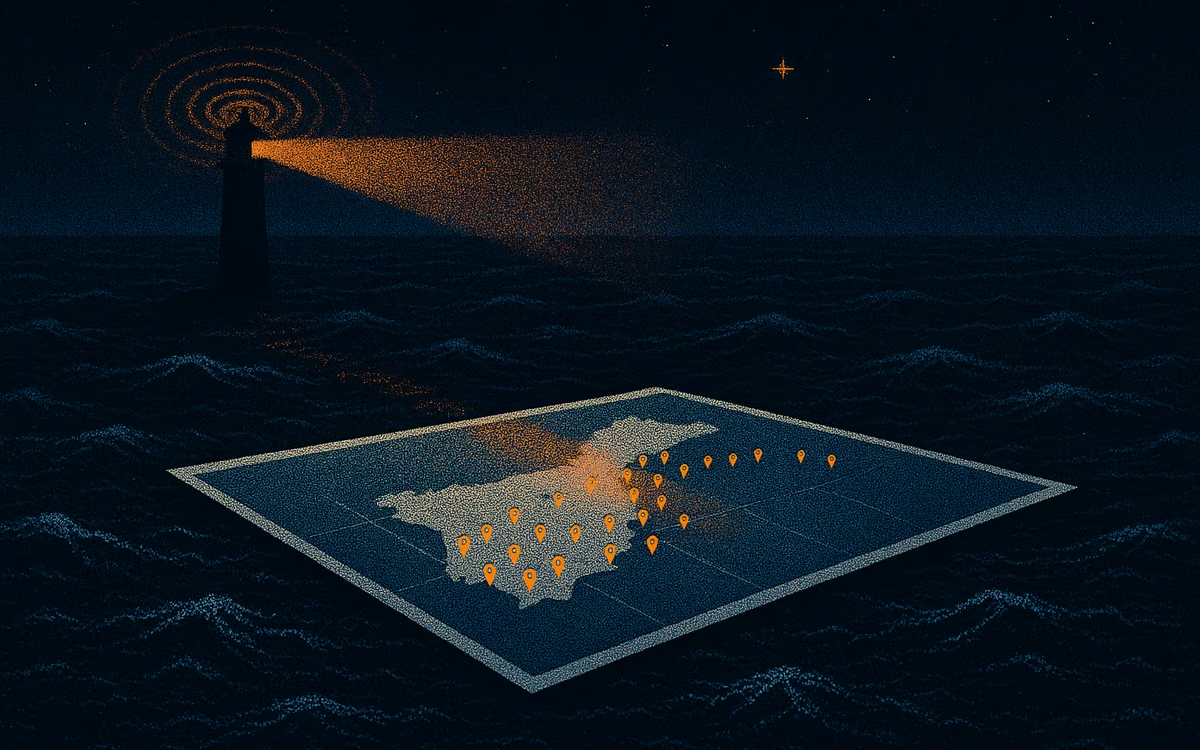
A Market Map is a single, always-current, account-level view of where every company in your market sits on the Demand Compass and which way it is moving. A Signal Radar is the instrument that keeps the Map honest: it reads every account's activity across both axes, the dark half that never becomes a form fill, and feeds what it catches straight into the Map. Two axes scored by hand once a quarter is not a system. The Map and the Radar are what turn "who is in the market this week?" from a guess into a standing answer.
What is a Market Map?
A Market Map is what you get when you run the Demand Compass across your whole market, continuously, instead of scoring twenty accounts by hand once a quarter. It is a single, always-current, account-level view of where every company sits on brand awareness and readiness to buy, and which way it is moving. Two axes scored manually go stale by the time anyone presents them; the Map is the version something keeps current without a person rebuilding it. It is the one picture sales and marketing finally orient around instead of arguing across.
The Map does not read the market on its own. Something else has to sweep it first.
What is a Signal Radar and how does it feed the Map?
The Signal Radar is the instrument that keeps the Market Map honest. It reads every account's activity across both axes of the Demand Compass, not the raised hands but the dark half: the brand mentions and repeat site visits that build the awareness score, and the pricing visits, docs reads and stack-naming job posts that build readiness. None of it is a form fill. The Radar is how the roughly eighty percent of a market that never gets mapped stops being invisible.
Every sensor in the stack, web de-anonymization, product and developer intent, job-post monitoring, community listening, event capture, trigger feeds, reports into the Map in one shape. A signal sitting inside one vendor's own dashboard, never flowing into the Map, is a signal a team does not actually have. Most deployments run something like twenty signals across one tool per sensor category, and the rule that keeps the stack from becoming a liability is to rent the scraping and name each sensor by the channel it watches rather than by the vendor behind it, so swapping the product later is a Tuesday, not a migration.
A signal that never reaches the Map is a signal you do not really have.
The Map is alive, not a snapshot. Decay keeps it moving: a Cold account that catches a trigger becomes In-Market overnight, and an In-Market account a team warmed but never closed drifts toward Sales-Ready or slides back to Nurture. When the Map comes up empty, that is rarely proof the market is dead. It is usually the demand-creation half of the system that was never built.
What are the four motions that keep the Map moving?
The Map tells a team where each account stands. What a team does about it is a motion, and there are four of them.
Three motions develop brand awareness, the axis a team builds rather than detects. Outbound reaches Cold accounts and makes them aware. Inbound attracts accounts and pulls them in through content and a point of view. Nurture keeps an aware-but-not-ready account warm until its readiness rises. None of those three convert on their own; their job is to fill the Map. The fourth motion, Activation, is the payoff: when the Signal Radar detects an aware account starting to react, on either axis, the team moves fast and closes it. That is the easiest deal a team will ever run, and the whole system exists to produce more of them.
| Motion | What it does | Converts? |
|---|---|---|
| Outbound | Reaches Cold accounts, makes them aware | No |
| Inbound | Attracts accounts, pulls them in | No |
| Nurture | Keeps aware accounts warm until ready | No |
| Activation | Acts fast on a reacting account | Yes |
A win is not the end of the wheel. A closed account does not drop back to Cold; it stays in Nurture, warm and watched, because the same Radar that found the first deal keeps reading it. When a new signal fires, a new team, a new project, a fresh burst of usage, Activation runs again to expand or upsell the account. The cheapest readiness a team will ever detect sits inside an account that already bought.
Why does this compound instead of just adding up?
The four motions do not sit in a line; they feed each other. The awareness Outbound, Inbound and Nurture build makes the readiness the Radar catches convert better, because an aware account answers the phone. The deals Activation closes produce revenue, the revenue funds more awareness work, and the loop turns again, each pass a little stronger than the last. A checklist is additive: a team gets out what it puts in. A flywheel compounds: the baseline keeps rising as the loop reinforces itself. That difference is why campaign-based demand generation, effort in, pipeline out, produces peaks and valleys while a Map and a Radar produce a floor.
Why does an intent tool show no intent in your market?
Almost always, the market is fine and the awareness motions were never built. Most teams buy an intent tool, wire up routing, wait for the Radar to light up, then conclude there just is not much intent to find. If nothing moves accounts from Cold to aware, few ever cross into the readiness a team is trying to catch. The system has two jobs, capture and creation, and a Radar that stays quiet is usually confessing that only half of it exists, not that the market went silent.
Related questions
Is a Market Map the same thing as a CRM?
No. A CRM records accounts a rep already touched, usually after a form fill. The Market Map covers the whole addressable market, aware or not, and updates itself from signal rather than from data entry.
Do I need a Signal Radar before I build a Market Map?
They are built together in practice, but the Radar comes first conceptually: without something reading the market, the Map is just a static list that goes stale the day it is drawn.
How many sensors does a Signal Radar need to be useful?
Most working deployments run around twenty signals across roughly one tool per sensor category. Web de-anonymization is usually the fastest one to stand up, because it resolves traffic a team already pays for.
What happens to an account after it closes?
It moves to Nurture, not off the Map. The Radar keeps reading it, and a fresh signal, a new hire, a new project, restarts Activation to expand or upsell it, the cheapest readiness a team will ever find.
Our market shows almost no buying intent. Is that a bad market?
Rarely. It is usually a system with only a capture half. Build the awareness motions, Outbound, Inbound and Nurture, before concluding the market itself has no demand in it.