
The blog · Pipeline Strategy · From The Demand Compass · 6 min
What are the signals that an account is ready to buy?
Three signal levels, industry, company and lead, and why only a company event plus lead behavior on the same account means the window is open.

Readiness to buy is internal momentum inside an account that makes your problem urgent now instead of someday, and it can only be detected, never created. Signals come at three levels, industry, company and lead, and real readiness is a composite: an event at the company level plus behavior at the lead level, on the same account, inside the same few weeks. The most reliable single signal is a new revenue leader in their first ninety days. Every readiness signal decays fast, so recency has to be built into the reading.
Why can readiness only be detected, not created?
Awareness, you build. Readiness, you cannot. That is the whole difference between the two axes of the Demand Compass, and it changes your job on this one.
The CFO does not free up budget because you wrote a clever subject line. Readiness happens inside the account, on its own schedule, driven by its own pressures. So readiness is not a persuasion problem. It is a detection problem. Accounts will enter the market whether you are watching or not; the only question is whether you see it first.
Readiness is not a persuasion problem. It is a detection problem.
And the window is rare. Professor John Dawes of the Ehrenberg-Bass Institute, in work published with the LinkedIn B2B Institute, put a number on it: in a typical B2B category only about 5 percent of buyers are in the market at any one time, because companies change providers roughly once every five years. Ninety-five percent are not ready today. Reach an account in the small slice when it is, and you are relevant. Reach it during the other ninety-five percent, and you are spam, no matter how good the message. Source: J. Dawes, Ehrenberg-Bass Institute, with the LinkedIn B2B Institute, 2021
A single visit can be a misclick, a competitor, a job seeker killing time; it's the repeat that means something.
What are the three levels of buying signals?
Since you cannot create the momentum, the whole game becomes three verbs: see it sooner than your competitors, read it more accurately, and move faster when it appears. Detection, interpretation, speed. A team that does those three things well on a mediocre product will out-pipeline one that does them badly on a great product.
Signals sort by level, and keeping the levels straight is what most teams get wrong.
- Industry. Broad shifts that move a whole market at once: a regulatory or policy change, a new compliance regime, a technology trend that resets what buyers expect.
- Company. Firmographic changes inside one account: a funding round that just loosened the budget, a new VP of Sales or Head of Revenue arriving with a mandate, an acquisition, a public security incident.
- Lead. The behavioral signals a person emits while working the problem: repeated visits to your pricing and docs, a free-tier signup that gets used, a stack-revealing job post, developer activity around technology next to yours. This level is mostly private; you only see it if you own the instrument that catches it.
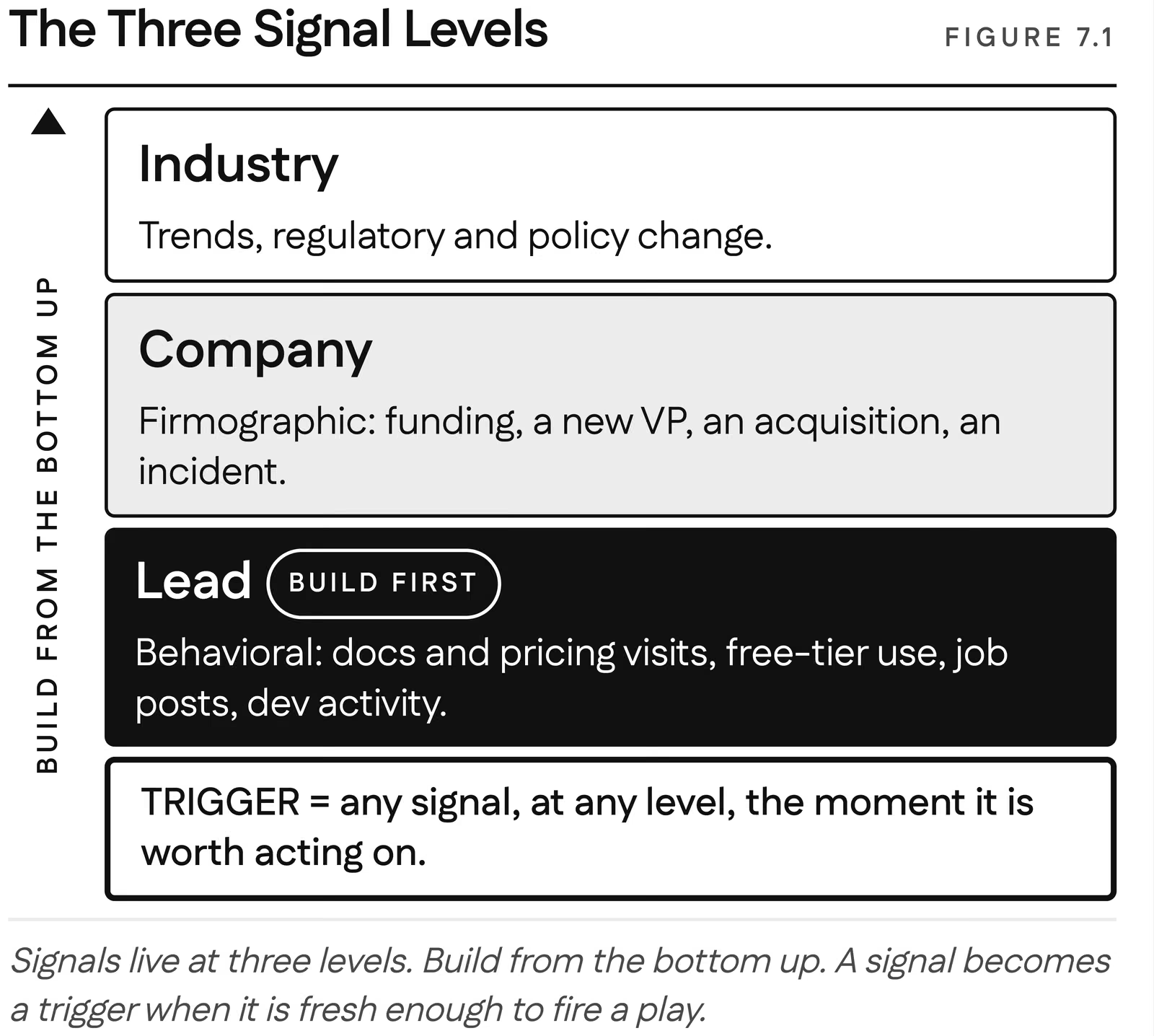
A word on a word, because it causes more confusion than any other. A trigger is not a fourth kind of signal. A trigger is what a signal becomes the moment it is fresh and strong enough to act on. A funding round sitting in a database is a company-level signal; the same round, caught this week on an account that fits, is a trigger, because now it fires something.
The ladder also decides where to start, and most teams start in the wrong place. Industry-level signals are the hardest to instrument; private, lead-level ones are the easiest, because you already own the tools that produce them. Build from the bottom up. Teams that begin at the top stall on the complexity; teams that begin at the lead level ship something that works in a week.
Why do most teams misread buying signals?
The trap on readiness is the opposite of the trap on awareness. Almost nobody tries to measure awareness; almost everybody thinks they have already solved readiness, usually by buying an intent tool and switching it on. The tool is real. The reading is where it falls apart, in three predictable ways.
The first is treating one signal as readiness. A single pricing-page visit lights up the dashboard, a rep pounces, and the prospect has no idea why a stranger is suddenly in their inbox acting like they raised a hand. A single visit can be a misclick, a competitor, a job seeker killing time. It is the repeat that means something. Readiness is several signals stacking on the same account, and a system that fires on any one in isolation mostly generates false alarms and annoyed buyers.
The second is reading the signal at the person instead of the account. The individual triggering the intent is often not the buyer. Roll it up to the account, or you will chase the wrong human and miss the real motion.
The third is ignoring decay, and this is where it hurts most. Readiness is the axis where evidence goes stale fastest: a docs visit this week is live; the same visit seven months ago is archaeology. Teams that let old readiness signals count at full weight chase windows that closed long ago.
What is the single most reliable buying signal?
If we had to keep only one readiness signal, it would be a new revenue leader in their first ninety days. Across the deployments we have run, nothing converts like it.
A new VP of Sales or Head of Revenue arrives, and the first thing they do is review the system they inherited: the stack, the motion, the vendors, what is working and what is not. Buying decisions that were frozen for a year suddenly get made, because someone new has both the mandate and the political cover to change things. The budget follows the mandate, and much of it gets committed inside that first ninety-day window, before the new habits harden. The signal is public, it is specific, and the window is sharp.
Your highest-value signal may differ, but the shape holds: a specific event, a clear mechanism, a known window, and a reason to move that belongs to the account, not to your quarter.
What determines results once a signal fires?
Because you cannot manufacture readiness, two things determine results.
Coverage means capturing the signal across the whole dark channel, not just the corner an intent tool happens to watch, and across your whole market, not just the fifth you have already mapped. A signal you do not capture is a window you do not see, which is why signal capture is usually the first function worth automating.
Speed means acting inside the window. After a signal like a new leader fires, you usually have thirty to sixty days before the account shortlists without you or settles back into inertia. Miss it, and someone else has the first conversation, the one that counts.
The response numbers follow. On email, a cold send replies in the low single digits, while the same channel aimed at people already aware of us has replied near twenty percent. On LinkedIn, a cold request to qualified leads gets accepted around a fifth of the time; point it at an account showing a real signal, or open with copy that speaks to that signal, and acceptance and replies climb by half again or more. The message barely changes, and it does not need to lean on urgency or a promise to earn the reply. What changes is that you are arriving at the window instead of knocking on a random door, and the account feels it in the first sentence.