
The blog · GTM Systems · From The Demand Compass · 7 min
What is website visitor de-anonymization and why start there?
The sensor to switch on first: it names the companies already reading your pricing and docs, on demand you paid to attract, and it is deployable this week.

Website visitor de-anonymization resolves the traffic on your site, most of which never fills out a form, to the named companies it came from, and at its best to the page each company read. It is the sensor to switch on first because it is the fastest to deploy and because it works on demand you already paid to attract: the accounts visiting your pricing and docs pages this week are invisible to your team until something names them. A visit to pricing or docs is worth roughly ten times a visit to your blog, and page-level intent resolved to a company is the highest-yield signal most teams skip.
What does website visitor de-anonymization actually do?
Website visitor de-anonymization is a sensor that takes anonymous traffic and resolves it to the account level, so that "a visitor from a large ISP" becomes "someone at a named company, on these pages, this week." Most companies on your site never fill out anything, but their visits are not anonymous at the account level, and the right sensor names the company and, better, the page. That second part is the point. A company that read your blog once is a curiosity. A company whose people hit your pricing page three times and your docs twice in ten days is telling you something, and you would never know without the sensor.
A signal is a dated piece of evidence that an account did something on one of the two axes, awareness or readiness. De-anonymized page visits are the most abundant readiness signal a B2B company has, because they come from the buyer's own research, which happens on your site whether or not anyone raises a hand.
Why start with the website rather than another sensor?
Start with the website because it is the fastest sensor to stand up and it resolves traffic you already pay to attract into named accounts you can act on. A demand engine needs its senses before it can score or route anything, and the sensor stack has several instruments: product and developer intent for technical buyers, the job-post X-ray, community listening, field and event capture, and an events feed for funding, hires and stack changes. Web de-anonymization is the one you can turn on this week, with no scraping to maintain and no list to build, and the first list it produces is usually the moment the whole idea stops being theoretical.
Some accounts have been visiting your pricing page for weeks while invisible to your team.
Some accounts have been visiting your pricing page for weeks while invisible to your team. Seeing that list changes the conversation inside a company faster than any deck about signals, because the names on it are companies the reps recognize.
What are the other sensors, and what does each see?
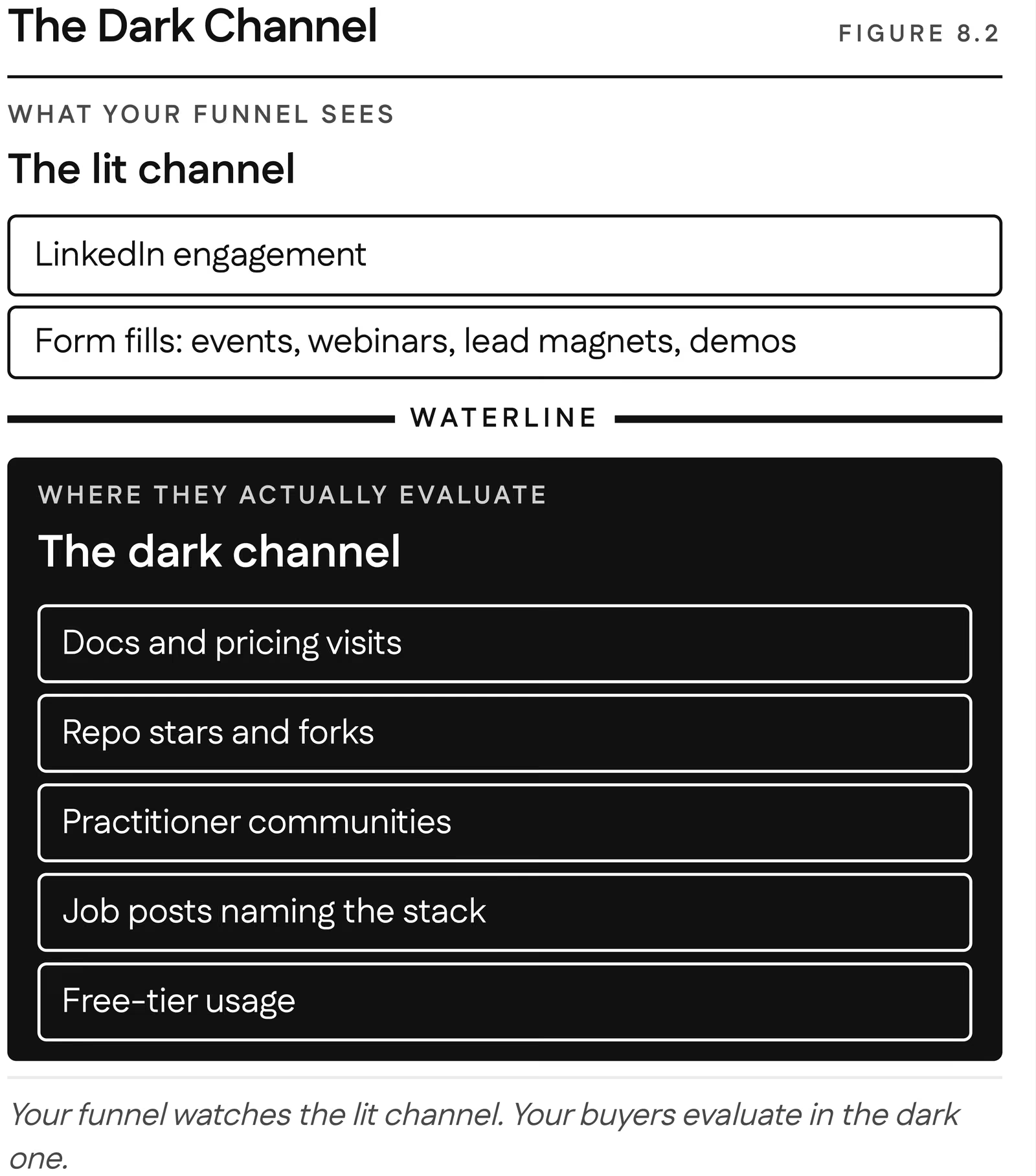
The sensor stack is a set of instruments, each watching one channel, all reporting to the same place. Product and developer intent watches repository activity, documentation and API usage, and free-tier behavior; for technical buyers it is the only sensor that sees the evaluation, which happens in code and docs, not on a form. The job-post X-ray reads a role for the stack a company is building, the function that is growing, and the seniority of the person hired to run it, so hiring becomes a standing readiness feed. Community listening catches the unprompted mentions in Reddit threads, Slack groups and practitioner forums where someone asks "has anyone used this?", the purest awareness signals there are and invisible without a sensor. The events feed watches funding rounds, leadership hires, tech-stack changes and regulatory shifts, the changes that reset an account's clock.
Field and event capture is the sensor teams waste the most money getting wrong. A team comes back from a conference with three hundred and forty badge scans and two weeks later has worked forty-seven, mostly the ones an AE added to the CRM by hand. The other two hundred and ninety-three sit in a CSV while the warm window closes. That team paid around eighty thousand dollars to attend and worked roughly fourteen percent of what it caught. The fix is not a better badge scanner; it is a sensor that receives the scans, enriches them, and routes them to the right play inside seventy-two hours.
| Sensor | What it sees | Axis |
|---|---|---|
| Web de-anonymization | Named companies on pricing, docs, product pages | Readiness |
| Product and developer intent | Repos, docs, API usage, free tier | Readiness |
| Job-post X-ray | Stack, growing function, seniority of the hire | Readiness |
| Community listening | Unprompted mentions in threads and forums | Awareness |
| Field and event capture | Badge scans, enriched and routed in 72 hours | Both |
| Events feed | Funding, hires, stack changes, regulation | Readiness |
What are the two rules for building the sensor stack?
Rent the scraping, and name the stack by channel. It is tempting for a technical team to build its own collectors, especially for anything LinkedIn-shaped. Do not. Scraping is a brittle, adversarial, full-time maintenance problem, and every hour keeping a scraper alive is an hour not spent on what is actually yours. Use managed scrapers and partner APIs. And think "the developer-intent sensor" rather than a product's name: vendors churn, the channel is permanent, and swapping the product later is a Tuesday rather than a migration, the same reason six sensor types beat any single intent vendor.
The second rule is the one that decides whether de-anonymization pays off. A visitor list inside the vendor's dashboard is a report. The same list flowing into the Market Map, next to the hiring signals and the community mentions for the same accounts, is an axis. The whole point of the map is that everything the Signal Radar reads, on both axes, lands in one account-level picture; a sensor that cannot feed it just makes another silo. Keeping that map current without a person rebuilding it every quarter is exactly what RevOps automation automates first.
Does the dark channel exist outside software?
The dark channel exists in every market; you only have to find where it lives for your buyers. It is easy to assume all this applies only to software companies with GitHub repositories and developer communities. Marcos learned otherwise far from dev tools. We have done some of our best work in unglamorous niches, packaging, spirits distribution, even commercial cleaning, and cleaning is the clearest lesson. There is no repository to watch and no docs page to instrument. So where does a commercial cleaning company's buying readiness show up? In new building developments: a development going up is a future cleaning contract forming. The sensor we built mapped the square footage of new developments across states and turned construction data into a readiness feed. The hard part was not the idea. It was the data foundation underneath, getting messy, scattered records into a shape you could score.
The research phase is also moving somewhere new. Demandbase measured monthly ChatGPT referrals to B2B websites rising from about 645,000 to 2.6 million in a single year, a 303 percent increase. Buyers are asking an assistant the questions they used to type into a search bar, in a place no ad reaches and no form can gate, and then arriving on your site already informed. De-anonymization is how you see them arrive. Source: Demandbase platform data, 2026
What does the sensor leave unsolved?
Capture leaves you with fragments, and fragments are not yet a score. Stand up the stack and signals pour in anonymous and partial: one engineer, one visit, one badge scan, one username in a thread. The next job is to turn "this visitor" and "this attendee" into "this company, doing these things," which is resolution, and it is where the enrichment waterfall earns its place. A de-anonymization sensor names the company. Something downstream still has to decide whether the company fits, attach it to the people who matter there, and read the visit against everything else the account did this month.
Related questions
Is website de-anonymization the same as intent data?
No. Intent data is a vendor's read of activity across third-party sites, one slice of the market's behavior. De-anonymization reads first-party behavior on your own site, page by page, which is why a pricing visit resolved to a company is worth more than a topic surge from a feed.
How much of my traffic will actually resolve to a company?
A fraction, and it depends on your audience and the vendor. Remote work and consumer networks hide some visitors. The share that resolves is still the share you were seeing none of before, and it is the share with the most buying intent, because it is people researching on your pages.
Is it legal and does it pass compliance review?
It resolves visits to companies, not to individuals, which is the distinction most privacy reviews turn on. Confirm the vendor's method and your own policy disclosure, and keep the resolved data in your own system rather than the vendor's dashboard.
What should I do with the list once I have it?
Nothing by hand, at first. Filter it to your ideal customer profile, score the page-level activity with recency, and feed it into the same account-level picture as your other signals. A rep should see "three pricing visits this week, a new VP of Sales last month," not a raw visitor log.