
The blog · Pipeline Strategy · From The Demand Compass · 7 min
Is the MQL dead, and what should replace it?
The MQL packed four separate questions into one score. What confused sales, why it collapsed, and the two-axis model that replaced it.

The MQL is dead as a qualification model, and the reason is not that it was a bad idea but that it packed four separate questions into one score: does the company fit, is this the right person, have they engaged with our marketing, and is the account ready to buy. Those four move independently, and the most expensive confusion is treating brand awareness and buying readiness as the same axis, when one you build and the other you can only detect. The result is a CRM full of leads that look qualified on paper and feel cold in the room, so sales stops trusting the source. What replaces it is not a better score but a reading of every account on two axes, awareness and readiness, with a different move for each position.
What does the MQL problem sound like in practice?
A CMO at a Series B company told us, almost apologizing: "I don't want my sales team chasing every MQL, spamming people who aren't ready." A few days later a VP of Sales said the opposite from the other side of the same wall: "We have hundreds of qualified leads sitting in the CRM. My reps tell me none of them are ready to buy." Then a marketing director, quieter: "Honestly, I don't even know who I'm allowed to target without stepping on sales' toes."
Three companies, three roles, one problem wearing three masks. None of them were bad at their jobs. They were running a qualification model that had quietly stopped working.
A lead count was always a proxy, and proxies survive only while the real number is unmeasurable.
Why was the MQL the right model in 2006?
This is not the LinkedIn version that farms engagement with "MQLs are dead" and then sells the same playbook under a new label. When SiriusDecisions introduced the Demand Waterfall in 2006, the marketing-qualified lead was a good idea. It brought structure to a handoff that had been chaos and finger-pointing. Source: SiriusDecisions, Demand Waterfall, 2006
But look at the world it was built for. Data was thin, enrichment slow and expensive, account context almost impossible to maintain at scale, behavioral signals hard to capture and harder to read. So teams compressed several questions into one stage, because keeping them apart was more than the tooling could bear. The constraints went away. The habit outlived them.
What four questions does an MQL collapse into one score?
An MQL became one bucket holding four different things. Account fit: is this even the kind of company we sell to? Contact relevance: is this the right person inside it? Engagement: has this person touched our marketing? Buying readiness: is something happening inside this account right now that makes them open to a conversation? Four questions, four realities, mixed into one score and handed to sales as if they were the same thing. We call it the MQL Collapse.
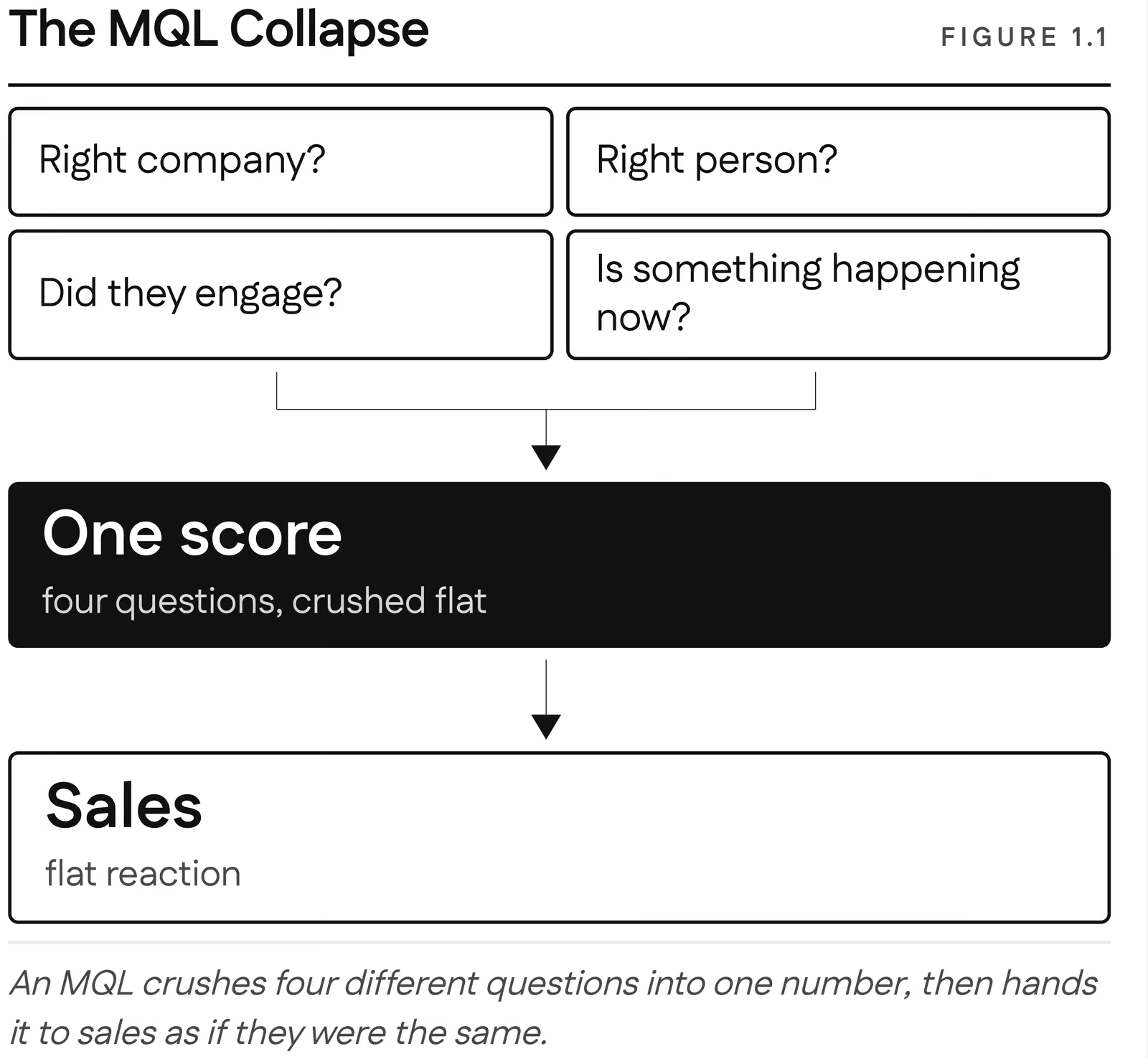
The collapse is why the CMO's team was spamming people who were not ready, and why the VP's reps were rejecting leads that scored well and went nowhere. A perfect contact at a perfect-fit company can open six emails, and none of that says whether the company has a reason to buy this quarter. The score says "qualified." The rep hears "curious."
Why are awareness and readiness different axes?
Of the four, the two that do the most damage when merged are brand awareness and buying readiness. Awareness answers: do they know us? Readiness answers something else: is there momentum inside this account right now? A budget approved, a competitor that failed them, a new VP with a mandate.
Why do sales reps reject marketing-qualified leads?
Here is the pattern we see in diagnostic after diagnostic. A new VP of Sales, three months in, sharp, has built teams before. His complaint: marketing keeps sending leads that are not ready, and his reps are calling people who have no idea who the company is. Marketing's response, equally firm: every one of those leads met the scoring criteria. They opened two emails, visited the pricing page, downloaded the guide.
Both are right. A lead who downloaded a guide is not necessarily ready for a call. But that same lead, if they also posted a question about tooling in a community last week, is in a completely different place, and sales never had that signal. Marketing did not know the company had ghosted a sales call eight months ago. Two teams, reading different parts of one account's story, arguing over the conclusion.
Twenty years of alignment conversations have not fixed this because they diagnose attitude and process. Marketing scores what it can see; sales rejects what it knows. The gap is everything neither can see, and you cannot close a data gap with a better meeting.
Marketing scores what it can see; sales rejects what it knows.
Why does the MQL miss technical buyers?
The model is most broken, and most fixable, when you sell complex products to engineers, security teams, data and platform teams. They leave a trail the MQL was never built to read: clone the repo, read the API docs three times, test the free tier at midnight, post a job that spells out the stack they are about to build. They evaluate you for months before they touch a form, and by then the decision is mostly made.
Then the part that breaks the funnel completely: the engineer leaves the signal, the executive signs the deal, and your funnel confuses the two. It waits for the VP or the CISO to raise a hand, and they never will, because that is not their job. The people actually evaluating you get ignored because they "don't have budget."
What does the MQL collapse cost a revenue team?
Take David's own outbound. A while back it was booking between four and eleven meetings a week. Then it fell, and kept falling, until he was fighting to hold two or three. More inboxes and more volume changed almost nothing, because he was spraying a market that had stopped rewarding spray. The day he started reaching out because something had actually happened inside an account, the numbers came back higher than before.
One number makes the point. A cold email with nothing behind it replies at one to three percent. We ran that exact channel into an audience that had engaged with our content first, and it replied at almost twenty percent, more than nine in ten of those replies positive. Close to ten times the result, same channel, barely different copy. Who you reach, and what they already know about you, is what moves that number. An MQL score cannot see either.
What happened when one company replaced the MQL?
Northwind, a composite of the cyber deployments we have run, was proud of a list of 3,200 "engaged" contacts. People who had opened emails, downloaded a guide, sat through a webinar. Sales would not touch it. The reps had learned that "engaged" meant a person was curious, not that a company was buying. So the list sat there, both sides annoyed.
Northwind did not add activity. It scored those same contacts against signals that meant something was happening inside the account. Of the 3,200, the Compass flagged 41 accounts as actually in-market that quarter. Not warmer versions of the rest: different accounts, surfaced because something had changed. Sales worked the 41 by hand. Nine became real opportunities, and three of those would not have been touched under the old list at all. The win was timing and signal, not more sending.
What replaces the MQL?
Not a better lead score. The fix is an instrument that reads every account on two axes, how aware they are of you and how ready they are to buy, and lets the position tell you the one move that fits. A compass does not tell you where to go; it tells you where you are, which is what a qualification model should have done all along. The handoff should not disappear. It should get far more precise.
Two warnings. Buying more tools will not save you; we have watched teams drown in point solutions, each chasing a single signal, none talking to the others, the same trap RevOps automation is meant to close: not another tool, but the model that decides what the tools already in the stack are for. And the first thing a two-axis reading gives you is not a flood of leads but clarity about which accounts deserve which move. The pipeline follows, always lagging.