
The blog · GTM Systems · From The Demand Compass · 7 min
What is the Demand Compass?
Two axes, four quadrants, one move each. The instrument that replaces the MQL with a reading of where every account actually stands.

The Demand Compass is a model that reads every account in a B2B market on two independent axes: brand awareness, which you build, and readiness to buy, which you can only detect. The two axes make four quadrants, and each quadrant comes with one owner and one next move. It replaces the single lead score, which collapsed both questions into one number and sent teams after the wrong accounts with the right message.
Why is it called a compass?
Start with the name. A compass does not bark "call this lead." It tells you where an account sits, so the right action becomes obvious. That distinction matters because most teams reach for the wrong fix when pipeline stalls: more activity, or one more score bolted onto the stack. The fix is seeing demand before the CRM calls it pipeline. Any score the Compass produces is a byproduct of that seeing, never the point.
Picture your market as a dark coast. Your accounts are harbors along it, most of them unlit. Your buyers are not leads to chase; they are ports to make. You win by reaching the harbors that are open on the tide and already know your flag, before another ship takes the berth. The Compass reads exactly those two bearings on every account: is this harbor open, and does it know you.
A compass doesn't tell you where to go; it tells you where you are, so you can decide the right move for yourself.
What are the two axes of the Demand Compass?
The MQL collapsed several realities into one score, and the worst collapse was treating brand awareness and buying readiness as the same thing. The Compass pulls them apart.
One axis is brand awareness. Do they know you, engage with your content, your point of view? Are you anywhere in their mental map of the category? You build this slowly, with everything you publish and every room you are in.
The other axis is readiness to buy: momentum inside the account right now. A budget freed up, a leader hired, a competitor failing them, a trigger that makes the problem urgent today. You cannot build or control this axis; you detect it, and you move when it appears. The awareness axis runs on the opposite clock: nothing to detect, only motions that build it over months.
You need both because they are independent. An account can know you well and have no reason to buy. Another can have a screaming reason to buy and have never heard your name. A single lead score rates them the same. Intent without awareness is noise; awareness without intent is vanity. The accounts worth acting on are the ones where you can see both.
Intent without awareness is noise; awareness without intent is vanity.
What are the four Demand Compass quadrants?
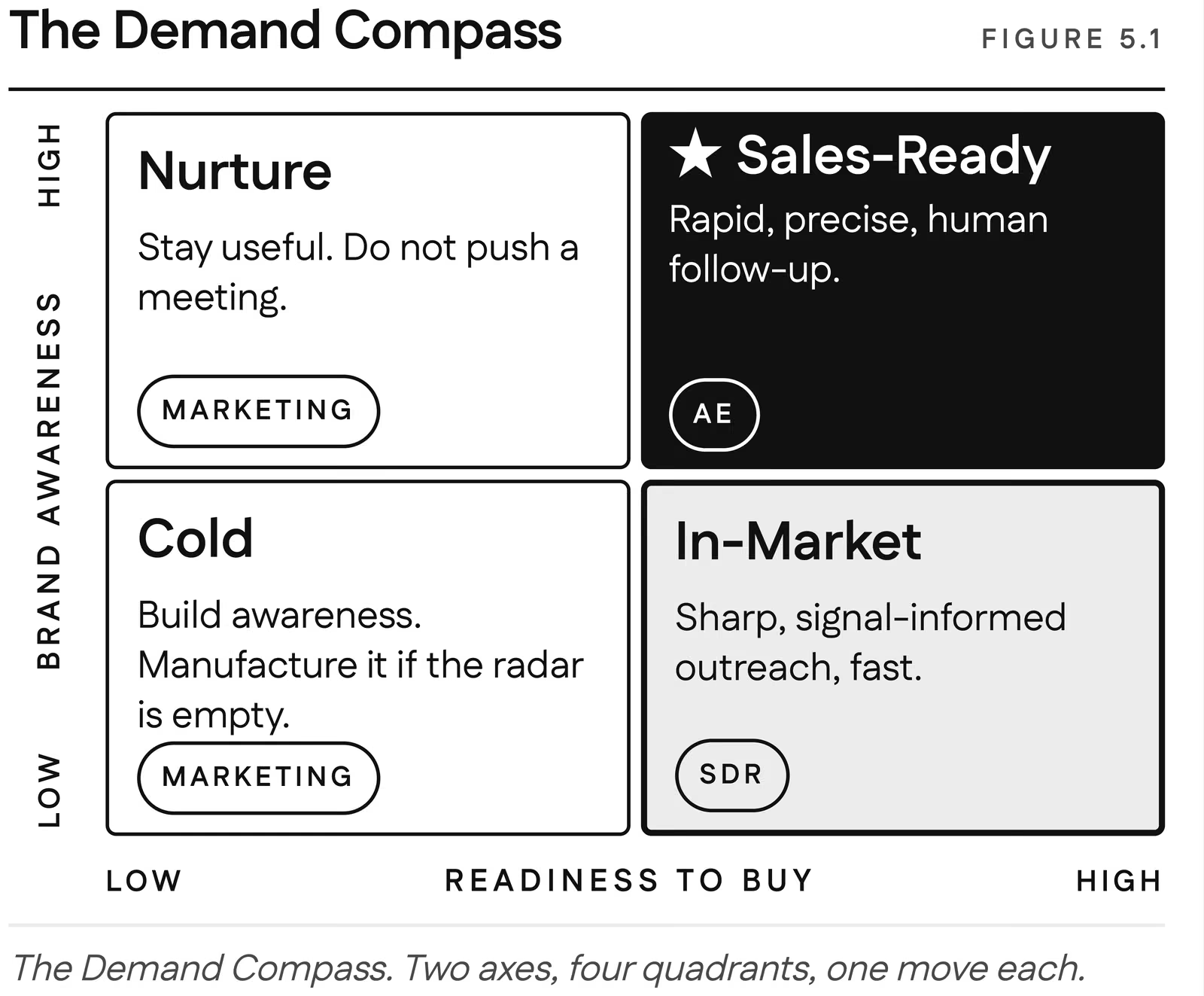
Draw the two axes as a square, awareness on one side and readiness on the other, and you get four quadrants. The value of the model is that an account's quadrant tells you its one move. Not a menu.
- Cold (low awareness, low readiness). Nothing is happening. The move is not to sell but to build awareness, and when nothing is signaling, to manufacture it. Owner: marketing.
- In-Market (low awareness, high readiness). Something is happening, but they have never heard of you. Sharp, signal-informed outreach that connects their priority to what you do. Speed beats polish; the window closes. Owner: the SDR.
- Nurture (high awareness, low readiness). They like your point of view, but there is no trigger yet. Stay visible and useful, and wait. This is the quadrant teams get wrong most often: pushing a Nurture account toward a meeting burns the awareness you spent a year building. Owner: marketing.
- Sales-Ready (high awareness, high readiness). The only quadrant where sales should move fast, with full context. Do not nurture, do not educate. Act. Owner: the AE.
What goes wrong when an account is in the wrong quadrant?
Three failures we see constantly are all position failures, not effort failures.
The CMO whose team is spamming people who are not ready is treating Nurture accounts, high awareness and no readiness, as if they were Sales-Ready. Right accounts, wrong quadrant, wrong move. The VP of Sales with a CRM full of "qualified" leads the reps will not touch is living the same error from the other side (why reps reject scored leads): marketing handed over Nurture accounts labeled ready, the reps could feel they were not, and they stopped trusting the source. The marketing director afraid of stepping on sales' toes has no map at all, so she cannot tell which quadrant an account is in or whose move it is.
None of these are messaging problems. The motion was fine, aimed wrong.
Why do signals decay in the Demand Compass?
An account's position is a reading of right now, and right now expires. A signal is evidence with a half-life. The engineer who read your docs this week is telling you something urgent; the same visit seven months ago, almost nothing. A funding round announced last month is a live trigger; the same round eighteen months later is history. Let every signal count forever and you do not have a compass, you have a graveyard that glows.
So readiness has to decay: recent signals carry close to full weight, older ones fade on a curve until they are gone. Awareness decays too, more slowly, because recognition lingers longer than urgency. We built a small version of this into our own outbound, and it changed the numbers: we never burn a sequence on a contact who went quiet six months ago. Old evidence dressed up as current is how good systems quietly lie.
How do you implement the Demand Compass?
Five steps, in order. First, validate fit, because awareness and readiness are meaningless for a company you would never sell to. Second and third, define your awareness signals and your readiness signals. Fourth, calibrate against real outcomes with decay built in; your first weighting is a hypothesis you test against whether these accounts convert. Fifth, attach an action to every quadrant: an owner, a response time, a message, a channel, an escalation. Without that last step the Compass is a diagram. With it, an operating model.
How is the Demand Compass different from ABM, intent data and lead scoring?
It is not account-based marketing with an intent tool bolted on. ABM picks the list; the Compass tells you what state each account on it is in. ABM is the guest list; the Compass reads the room.
It is not intent data. Intent gives you one axis, readiness, usually a noisy version of it, and says nothing about whether the account has heard of you. That is the difference between a relevant conversation and an ambush. The Compass refuses to act on intent alone, because intent without awareness is the cold spam the last era trained buyers to delete.
It is not lead scoring. Lead scoring blends people into a single number. The Compass scores accounts, on two axes, with an audit trail. Same verb, opposite result.
And it is the operational half of the 95-5 rule: the finding that only about five percent of B2B buyers are in the market at any moment. That research is right, and the Compass measures which five percent is moving now while proving the awareness you build in the other ninety-five pays off. Mental availability is the strategy; the Compass is the instrument.
When does the Demand Compass not apply?
If you sell a low-consideration, high-volume product where the buyer decides in an afternoon, this is overkill; a simple form and a fast follow-up will beat a two-axis model you did not need. The Compass earns its keep when deals are considered, cycles are long, a committee is involved, and an account is worth more than the cost of reading it. And where the buying trigger genuinely leaves no trace, lean on the awareness axis and be relentless there. The Compass does not pretend to detect what cannot be detected; it tells you which half of the map you can instrument.