
The blog · GTM Systems · From The Demand Compass · 6 min
How do you build a signal-based demand system in 90 days?
One definition of a workable lead on day one, one sensor in month one, one play in month two, one board story in month three. Narrow and working beats wide and broken.

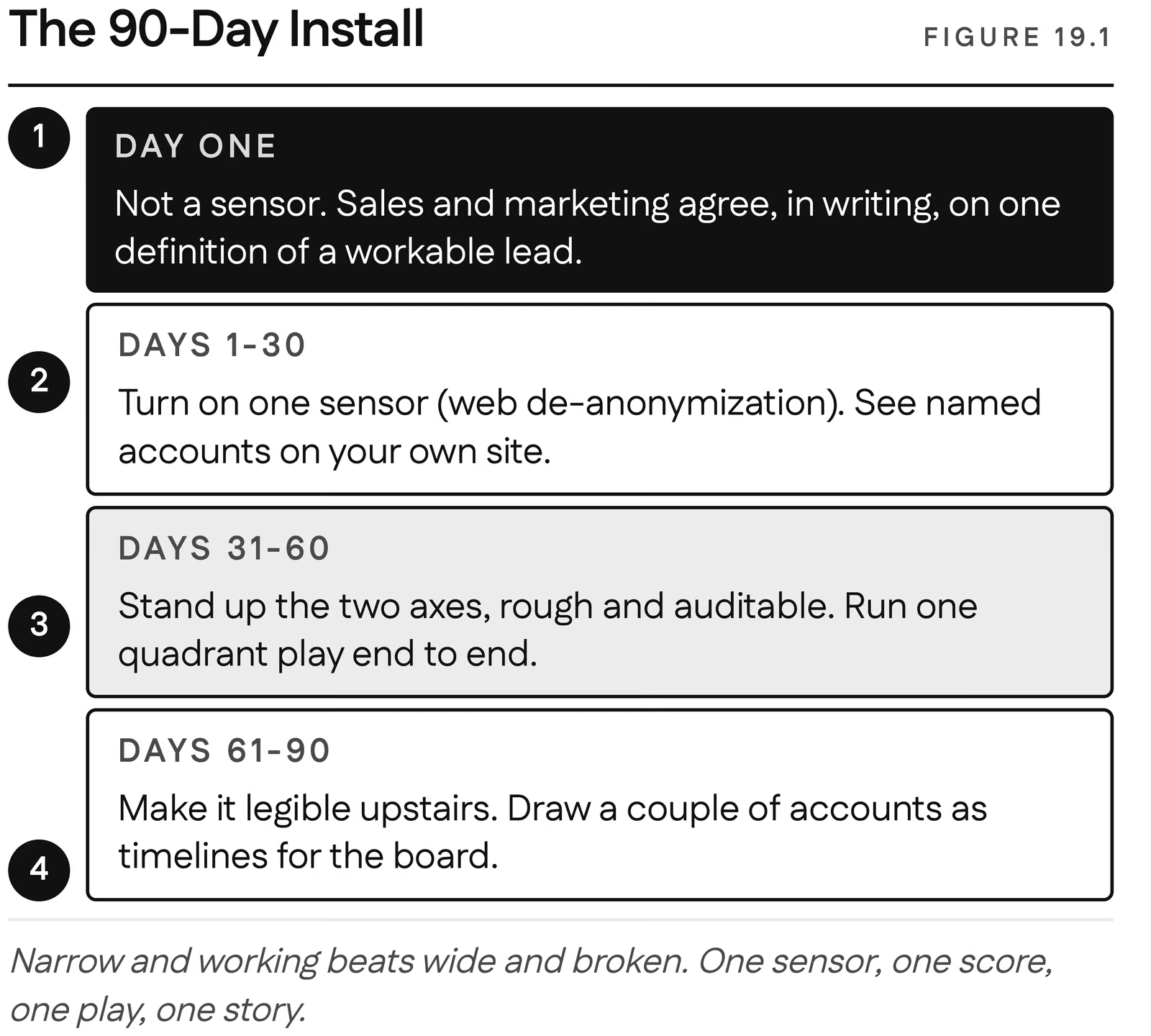
You build a signal-based demand system in ninety days by building one narrow slice, not the whole thing. Day one is an agreement between sales and marketing on what a workable lead is. The first thirty days turn on one sensor and map the market. The next thirty score accounts on two axes and run one play. The last thirty make the result legible to the board. At ninety days you have one sensor, a rough score, one play producing replies and one board-ready story: a working slice of the real system.
Why not build the whole signal system at once?
Building the whole system at once fails because it takes a year and stalls before anything works. The full build means six sensors, both axes of the Demand Compass, every quadrant play, a learning loop and a board layer in one project. We have watched teams do that, and done a version of it ourselves. The system that actually gets built produces a visible win early, because momentum and budget come from a working slice, never from a finished blueprint.
So the install is a sequence: ninety days, one thing at a time, each step producing something real before the next one starts.
Momentum and budget come from a working slice, never from a finished blueprint.
What do you do on day one?
On day one the Demand Compass install starts with a conversation, not a tool: sales and marketing agree, in writing, on one definition of a workable lead and one handoff. A flawless engine that routes to a team that does not believe the definition is only a faster way to get ignored. Negotiate it while you have the goodwill of being new, not after the first disputed lead.
Before any technology, also diagnose the moment you are walking into. A consolidated sales team with installed habits is a different build than a new team with none, and the difference decides what you can land. Promise results before you have read the room and you will produce great work that fights the tide.
What do you build in the first thirty days?
In the first thirty days the install turns on exactly one sensor, web de-anonymization, and maps the addressable market as accounts. Web de-anonymization resolves traffic you already pay to attract into named companies, and it produces a result in days. Mapping the market at the same time gives the signals somewhere to land.
That second part matters more than it looks. When we assess a team, most are actively touching fifteen to twenty percent of their addressable market. The other eighty percent is not missing because the buyers are not there; it is missing because nobody ever mapped it. These are our own deployment findings.
By the end of the month you should have something you have never had: a ranked list of real companies showing readiness on your own site, assembled automatically. That is the first visible win. Show it around. It earns you the room to keep going.
What do you build in days 31 to 60?
In days 31 to 60 the install stands up the two Compass axes on whatever you can capture, even a rough version, with the audit trail attached so every score carries its reasons. Do not wait for the perfect model. A simple, explainable score a rep can trust beats a sophisticated one nobody believes.
Then run exactly one quadrant play, end to end. Pick In-Market: low awareness and high readiness, the accounts that convert fastest and prove the model in the least time. Send a signal-informed sequence to the accounts your sensor surfaced, with the why-now riding along to the rep.
The reference point is the cold baseline. A cold email with nothing behind it replies at one to three percent; in our deployments, signal-led outreach into accounts in motion has replied far above that. When your replies come back several times stronger than cold, you no longer have a theory. You have evidence, produced by your own team on your own market, the only kind that changes minds.
| Window | What you build | What you can show |
|---|---|---|
| Day one | One written definition of a workable lead | Sales and marketing on the same page |
| Days 1 to 30 | One sensor, plus the market mapped as accounts | A ranked list of named accounts on your own site |
| Days 31 to 60 | Two rough axes with an audit trail, one In-Market play | Replies well above your cold baseline |
| Days 61 to 90 | The translation layer for the board | Accounts drawn as timelines |
What do you build in the last thirty days?
In the last thirty days the install builds the translation layer for one audience: the board. Take a couple of accounts the system worked and draw them as timelines, the awareness and signals that preceded the pipeline, so the value is visible to the people who control the budget.
If your Signal Radar came up thin, this is also when you start the awareness motions, Inbound and Outbound, the demand-creation work that fills it over the next quarter. A quiet radar usually means the market is fine and the awareness half was never built.
At ninety days you do not have the whole machine. You have one sensor, a rough two-axis score, one quadrant play producing replies and one board-ready story. That is not a prototype. It is a working slice of the real system, producing results and funding its own expansion.
Why does narrow beat wide?
Narrow beats wide because a narrow slice that works compounds, while a wide system that does not work generates doubt, and doubt gets the budget pulled. The discipline throughout is restraint: one sensor, not six; one play, not four; one board story, not a dashboard. Every instinct, especially on a capable team, pushes toward building it all in parallel, and that instinct is how these projects die.
Because the whole thing is infrastructure, every ninety days adds a capability to a system already producing. The slice you build this quarter is the foundation the next one stands on.
The do-it-yourself path goes one sensor at a time. Working with us looks different, because you are not starting from a blank page: we bring the connectors, scoring and documentation already built, so we can stand up several signals at once and compress months into weeks. We still start tight, capturing the best leads from the systems a company already has, the CRM, the newsletter, the existing databases, and prove that slice works before layering on the next. The narrow first win is about evidence and trust, not how many signals we can technically deploy.
Related questions
Do you need to buy a platform before day one?
No. Day one needs a meeting and a written definition of a workable lead, and costs nothing. You need one honest conversation and one sensor switched on, not a platform, a budget or a large team.
Why start with web de-anonymization and not another sensor?
It resolves traffic you already pay to attract into named accounts, and it produces a result in days rather than quarters. That early, visible win is what buys the room for everything after it.
Why run the In-Market play first?
In-Market accounts have high readiness and low awareness, so they convert fastest and prove the model in the least time. One signal-informed sequence, with the why-now passed to the rep, is enough to test it.
What if the Signal Radar is thin at day sixty?
Start the awareness motions in the last thirty days, Inbound and Outbound, and read the radar again next quarter. Thin signal in a market that has never heard of you is a creation problem, not a sensor problem.
Is the ninety days a fixed schedule?
The order is fixed and the dates are not. What matters is that each step produces something real before the next one starts, and that you resist building the next layer before the current one works.